Form 15CA/15CB for NRIs: the USD 1 million NRO repatriation limit
Form 15CA/15CB for NRI remittances: when Form 15CB is needed, the USD 1 million NRO cap, and the April 2026 renumbering to Form 145/146.
Money sitting in an NRO account is money that hasn’t finished its journey. You sold the flat, the buyer deducted TDS, the sale closed, and now ₹2.18 crore is parked in an account you can’t spend from. Getting it to your bank in Dubai or Dallas is a separate exercise with its own rulebook, and the rulebook changed on 1 April 2026. If you plan the sale and the remittance as two unrelated things, you will lose a quarter and possibly a financial year.
Here’s the short version. You can move up to USD 1 million per financial year out of your NRO account. That’s roughly ₹8.8 crore. A large amount of what NRIs actually want to remit doesn’t count against that number at all. And the two forms everyone calls 15CA and 15CB now have different names.
What the USD 1 million limit actually covers
The cap comes from FEMA, not the Income-tax Act. RBI’s Master Direction on Remittance of Assets lets an authorised dealer bank remit up to USD 1 million per financial year, per person, out of balances held in an NRO account.
What sits inside the cap:
- Sale proceeds of immovable property in India
- Assets received by inheritance, will, or settlement
- Balances built up in the NRO account over the years
- Proceeds of investments you originally made on a non-repatriable basis
The limit is per financial year, per PAN. It resets on 1 April and does not carry forward. Unused headroom in FY 2025-26 is gone. If you’re remitting something very large, splitting it across a 31 March boundary buys you a second million without asking anyone’s permission.
The cap is far bigger than most people think
This is where I’ll be blunt, because the panic is misplaced.
At roughly ₹88 to the dollar in July 2026, USD 1 million is about ₹8.84 crore a year. I don’t know where the rupee lands by March, and a weaker rupee actually makes the cap roomier in rupee terms. But at anything near current levels, a single NRI remitting a normal Indian portfolio will never touch it.
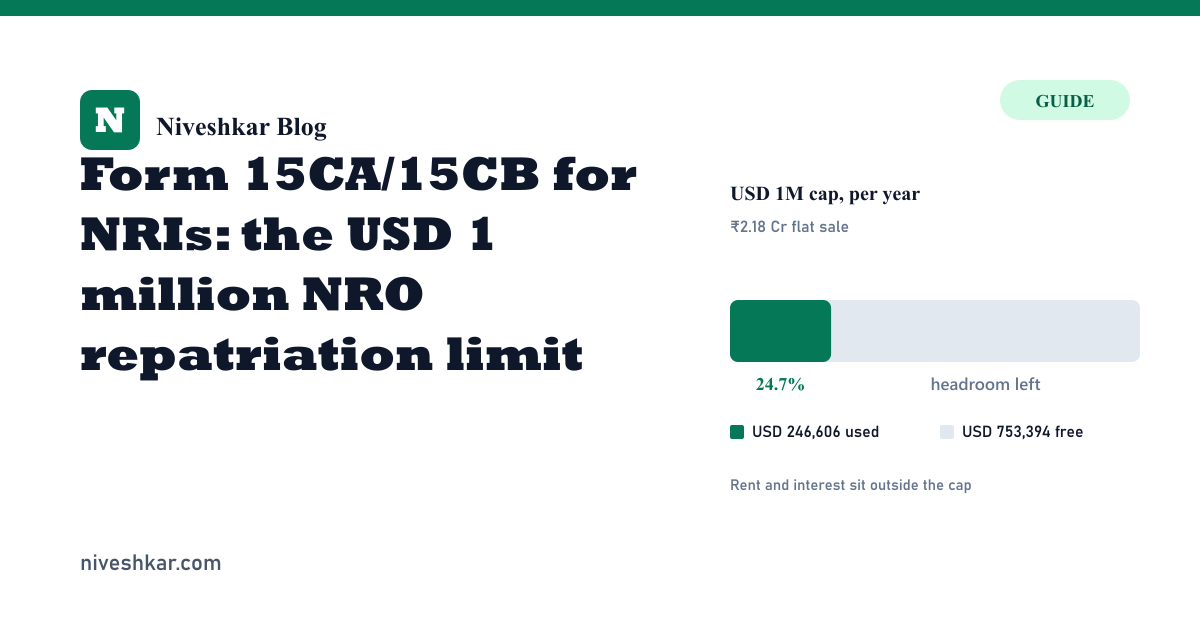
Run the numbers on a fairly rich case. Sell a Bengaluru flat for ₹2.4 crore, settle the capital gains, and you’re left with ₹2.18 crore. Converted, that’s USD 246,606. You’ve used a quarter of the year’s allowance and have USD 753,394 still available.
Married couple, both NRIs, both with PANs? Two separate limits. Property held jointly, remitted from two NRO accounts, and you’re at USD 2 million a year before anything binds.
The people who genuinely hit the cap are the ones liquidating ancestral property in Mumbai or Delhi worth ₹15 crore-plus. For them the fix is scheduling, not paperwork. Everyone else is worrying about the wrong constraint. The real bottleneck is TDS, which locks up cash for eighteen months, not FEMA, which lets you take out more than you have.
Three things that don’t count against the cap at all
This is the section worth reading twice, because banks get it wrong routinely.
Current income is outside the limit. Rent, dividends, interest, and pension are current income. RBI allows an authorised dealer to remit these freely, without any monetary ceiling, once the bank is satisfied that tax has been paid or deducted. They should not be debited against your USD 1 million headroom.
Say you own a Chennai flat rented at ₹95,000 a month and hold ₹60 lakh in NRO fixed deposits at 7%. That’s ₹11.4 lakh of rent plus ₹4.2 lakh of interest, ₹15.6 lakh of current income for the year. Every rupee of it is remittable after tax without eating into the cap. I’ve seen bank relationship managers block the whole thing into the USD 1 million bucket because it’s easier to run one process. Push back. Ask for it to be treated as current income under the Remittance of Assets Master Direction and give them the rent agreement and the interest certificate.
NRE and FCNR balances aren’t capped. They were funded with foreign currency in the first place, so principal and interest are both fully and freely repatriable. Nothing to compute.
Original foreign-currency investment in up to two residential properties. If you bought a house by remitting money in through your NRE or FCNR account, you can take back an amount equal to that original foreign-currency investment outside the USD 1 million limit. The concession is restricted to two residential properties, and it applies only to residential ones. Commercial property, plots, agricultural land and plantation property fall under the general cap.
An example. Meera remitted USD 310,000 through her NRE account in 2016 to buy a Gurgaon flat. She sells it in 2026 and, after tax, has ₹5.6 crore to move. The USD 310,000 comes back as return of original investment and doesn’t touch the cap. Only the balance above that, about ₹2.87 crore or USD 324,660, is charged to her USD 1 million allowance. Total out that year: roughly USD 635,000, of which barely half counts.
Your bank will want the FIRC (Foreign Inward Remittance Certificate) from 2016 to prove the original inflow. Nobody keeps these. Ask your bank for a duplicate before you list the property, not after you’ve signed the sale deed.
Form 15CA and Form 15CB are now Form 145 and Form 146
The Income-tax Rules that took effect on 1 April 2026, alongside the Income-tax Act, 2025, renumbered both forms. Form 15CA is now Form 145. Form 15CB, the chartered accountant’s certificate, is now Form 146.
The old Section 195, which governs TDS on payments to non-residents, is now Section 393(2) of the 2025 Act.
Nothing substantive changed. Same ₹5 lakh threshold, same four parts, same exemption list carried over from Rule 37BB with its 33 categories of payments that need no form at all. It’s a renumbering, not a reform. But your bank’s forms, your CA’s templates, and roughly every article you’ll find online still say 15CA and 15CB, so expect friction and be ready to say both names in the same sentence.
Which part of Form 15CA applies to you
Form 15CA (145) has four parts and you file exactly one. The trigger is the aggregate of remittances during the financial year, not the size of a single transfer.
| Part | When it applies | CA certificate needed? |
|---|---|---|
| Part A | Aggregate remittances in the FY are ₹5 lakh or less | No |
| Part B | Above ₹5 lakh, and you hold an order or certificate from the Assessing Officer under Section 195(2), 195(3) or 197 | No |
| Part C | Above ₹5 lakh, taxable, and you’re relying on a CA’s certificate | Yes, Form 15CB (146) |
| Part D | The remittance isn’t chargeable to tax in India at all | No |
Most NRO repatriations of any size land in Part C. Note the order of operations, which trips people up: the CA files Form 15CB first, then you file Form 15CA quoting its acknowledgement number, then the bank processes the remittance against Form A2, the FEMA declaration. Three documents, in that sequence. A bank that asks for all three simultaneously is a bank that will bounce the file.
Fees for the CA certificate run around ₹5,000 per remittance in my experience, more if the taxability is genuinely arguable. Which is an argument for fewer, larger remittances rather than monthly dribbles.
Skipping the form is expensive. Failure to furnish it, or furnishing wrong particulars, attracts a ₹1 lakh penalty under Section 271-I. That section was renumbered in the 2025 Act and I haven’t confirmed the new number, so ask your CA to cite the current provision rather than quoting this post at your Assessing Officer.
Worked example: ₹2.18 crore out of a Bengaluru flat sale
Ravi lives in Dubai and sold his Bengaluru flat in May 2026. Bought in 2011 for ₹62 lakh, sold for ₹2.4 crore.
The capital gain is ₹1.78 crore. Here’s the part that surprises NRIs: the Finance Act 2024 grandfathering, the one that lets you pick the lower of 20% with indexation or 12.5% without, applies only to resident individuals and HUFs. Ravi doesn’t get the choice. He pays a flat 12.5% without indexation.
- LTCG: ₹2,40,00,000 minus ₹62,00,000 = ₹1,78,00,000
- Tax at 12.5%: ₹22,25,000, plus surcharge and 4% cess
Meanwhile the buyer was required to deduct TDS under Section 393(2) on the entire sale consideration, not the gain, unless Ravi obtained a lower-deduction certificate first. On ₹2.4 crore that’s a deduction in the region of ₹30 lakh against an actual liability nearer ₹23 lakh. Work through your own numbers on the NRI property-sale TDS calculator and read the Section 195 guide before you sign anything, because a Form 13 application filed in advance is the difference between a smooth remittance and an eighteen-month refund wait.
Assume he did it properly and ₹2.18 crore reaches his NRO account. To remit:
- CA reviews the sale deed, the tax challan and the return position, issues Form 146 (15CB)
- Ravi files Form 145 (15CA) Part C on the income tax portal, quoting the 146 acknowledgement
- Bank takes both plus Form A2, the sale deed and PAN, and remits
- USD 246,606 leaves the cap. USD 753,394 of headroom remains for FY 2026-27
Four steps. Two of them need a chartered accountant. Budget three weeks, not three days, especially if the property was inherited and the chain of title needs documenting.
NRO to NRE is a repatriation, not a transfer
People treat moving money from their own NRO account to their own NRE account at the same bank as an internal transfer. It isn’t. It’s a repatriation under FEMA, it counts against the same USD 1 million, and it needs the same Form 145 and Form 146.
The reason to do it anyway is that once money is in the NRE account it’s freely repatriable forever, with no further paperwork and no cap. If you’re going to need the money abroad eventually but not this quarter, moving it to NRE now converts a restricted balance into an unrestricted one at today’s cap. That’s worth doing in a year when you have spare headroom.
Where this actually goes wrong
Not the cap. The mismatch.
The bank’s remittance desk checks whether the tax position stated in Form 146 matches what actually got paid. If your CA certifies tax paid on a ₹1.78 crore gain but the Form 26AS trail shows TDS deducted on ₹2.4 crore of consideration with no return filed reconciling the two, the file stalls. Not rejected. Stalled, which is worse, because nobody tells you.
Fix the sequence. File the return, let the refund position crystallise, then remit. Your ITR for FY 2025-26 is due 31 July 2026, and if you’re remitting anything substantial this year, filing on time isn’t a compliance chore, it’s the thing that unblocks your money.
The second failure is treaty relief left unclaimed on NRO interest. Domestic TDS on NRO interest is 30% plus surcharge and cess. On ₹4.2 lakh of interest that’s ₹1,31,040 gone. A treaty capping interest at 15% would take ₹63,000 instead, a difference of ₹68,040, but only if you filed a TRC and Form 10F with the bank before the interest was credited. Model it on the DTAA relief calculator and read the DTAA guide if you haven’t done that paperwork.
Third, and smallest, but it costs a full year: nobody checks their remaining headroom before starting. Ask your bank for a statement of repatriations already made this financial year across all your NRO accounts, because the limit is aggregated per PAN, not per account. Two banks, two relationship managers, neither of whom knows about the other, and you find out at the wrong moment.
I’d start every large remittance by asking for that number. Takes one email. Saves a quarter.
References
- RBI Master Directions index (Remittance of Assets, RBI/FED/2015-16/8)
- Form 15CA FAQs, Income Tax Department
- FEMA Notification No. 13/2000-RB and the Remittance of Assets Regulations, USD 1 million per financial year facility
- Rule 37BB, Income-tax Rules 1962, Form 15CA/15CB and the 33-item specified exemption list
- Income-tax Rules 2026, in force 1 April 2026: Form 15CA renumbered Form 145, Form 15CB renumbered Form 146
- Income-tax Act, 2025, Section 393(2), successor to Section 195 of the 1961 Act
- Section 271-I, Income-tax Act 1961, ₹1 lakh penalty for failure to furnish Form 15CA